
















The United States and Russia are entering a new phase of nuclear relations with no treaty limiting their arsenals, as President Donald Trump calls for a sweeping new arms control agreement and Russian officials warn that Washington’s approach would make any deal impossible.
The last agreement that capped U.S. and Russian nuclear weapons, known as New START, expired Thursday, leaving the world’s two largest nuclear powers without legally binding limits on their arsenals or an inspection regime.
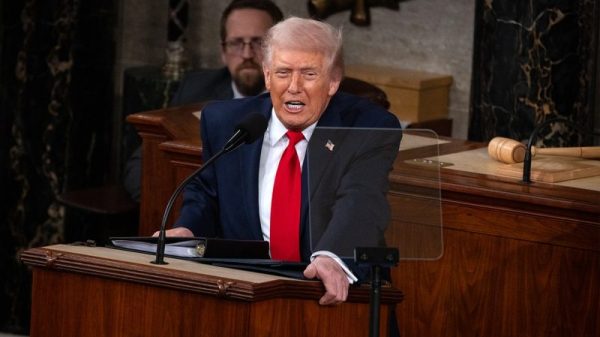
Trump called New START a ‘bad deal’ that was being ‘grossly violated,’ and said the United States should instead pursue a ‘new, improved and modernized treaty.’
Russian officials quickly pushed back. Dmitry Medvedev, deputy chair of Russia’s security council, said U.S. criticism of New START ‘means one thing: there’ll never be a treaty under these terms,’ arguing Washington is demanding limits that ignore other nuclear-armed states and new weapons systems.
The United States and Russia have entered a new phase of nuclear relations with no treaty now limiting their arsenals, after the last remaining arms control agreement between the two powers expired this week. As the two powers seek to negotiate a new framework, each is seeking to expand restrictions on each other’s allies, with the U.S. aiming to include China, and Russia countering by saying Britain and France should also be covered.
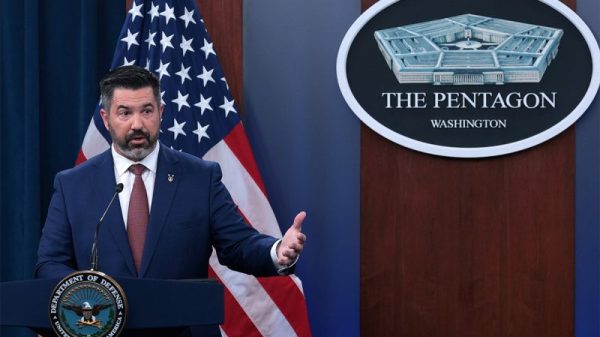
Speaking Wednesday at the Conference on Disarmament, Under Secretary of State for Arms Control and International Security Thomas DiNanno said New START’s limits no longer reflect today’s nuclear landscape.
‘As of yesterday, New START and its central limits have expired,’ DiNanno said. ‘Even if we could have legally extended the treaty, it would not have been beneficial for the United States — or the world — to do so.’
‘A bilateral treaty with only one nuclear power is simply inappropriate in 2026 and going forward,’ DiNanno said, pointing to Russia’s tactical nuclear weapons and China’s unconstrained buildup.
In practice, New START’s verification regime had already been largely dormant since 2023, when Russia stopped allowing on-site inspections of its nuclear facilities and halted required data exchanges under the treaty, even as both sides said they continued to observe its numerical limits.
But China remains far behind the United States and Russia in overall nuclear warheads and is unlikely to accept binding limits while it is still expanding its arsenal, arms control experts say.
The United States and Russia each maintain roughly 4,000 total nuclear warheads, with about 1,700 deployed on strategic delivery systems, according to expert estimates. China, by contrast, is projected to reach about 1,000 warheads by 2030.
Arms control experts caution that while New START had clear shortcomings, its expiration still removes an important stabilizing mechanism. Lynn Rusten, a former senior U.S. arms control official now at the Center for European Policy Analysis, said the treaty provided a foundation that is now gone.
‘We did lose something,’ Rusten told Fox News Digital. ‘It would have been good to continue that as a foundation and a stabilizing platform on which to negotiate a better deal.’
The growing uncertainty comes as the Bulletin of the Atomic Scientists last month moved its symbolic Doomsday Clock to 85 seconds to midnight — the closest it has ever been to global catastrophe — citing rising nuclear risks, the collapse of arms control frameworks, and intensifying great-power competition.
Rusten said the immediate concern is not a rapid buildup of new missiles or bombers, but how many warheads each side could deploy on systems they already have.
‘Both countries have the capacity to increase deployed warheads on their existing strategic delivery vehicles,’ she said. ‘It would take time, but they could add several hundred if they chose to.’
Russia has also developed a number of nontraditional delivery systems that were not limited by New START.
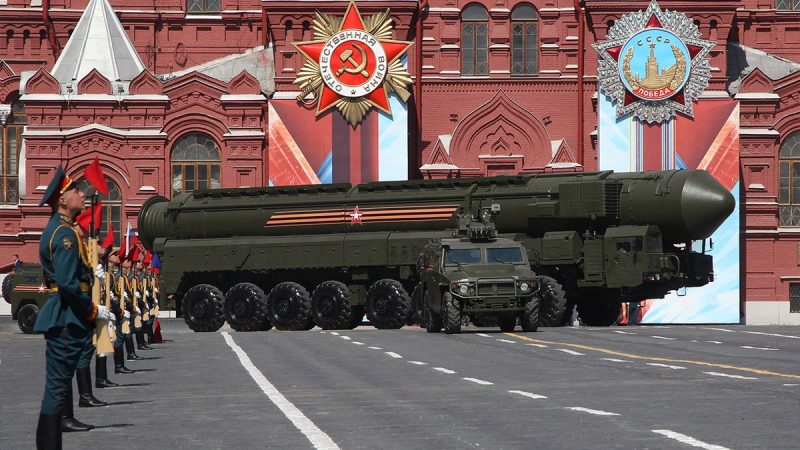
Those systems include a nuclear-powered cruise missile known as Burevestnik, sometimes referred to as Skyfall, and a nuclear-powered underwater torpedo called Poseidon — weapons Moscow has touted as capable of evading existing missile defenses and striking targets at intercontinental range.
‘Those are systems that really should be included in any future treaty,’ Rusten said. ‘They’re troubling because they’re just adding to the number and type of strategic-range nuclear systems that can kill huge numbers of people.’
Separate from those novel strategic systems, experts say one of the biggest unresolved issues in nuclear arms control involves so-called tactical, or non-strategic, nuclear weapons — shorter-range nuclear arms designed for battlefield use rather than long-range strikes against cities.
Russia is believed to possess far more of these weapons than the United States, and they have never been subject to legally binding arms control limits. While Washington drastically reduced its tactical nuclear stockpile after the Cold War, Moscow retained and later modernized many of its own, viewing them as a key tool to offset NATO’s conventional military strength.
‘Russia has thousands of tactical nuclear weapons, and they’ve never been covered by a treaty,’ Rusten said. ‘That’s been a long-standing concern for the United States and our NATO allies, and it’s one of the hardest issues to negotiate.’
Because they are smaller, more flexible, and potentially usable earlier in a conflict, experts say tactical nuclear weapons pose a unique escalation risk — lowering the threshold for nuclear use and complicating efforts to prevent a crisis from spiraling into a broader nuclear exchange.